A Transportation Safety Board of Canada (TSB) investigation into a collision at the Woodfibre LNG project site near Squamish, Canada, identifies blocked sightlines and the absence of a posted lookout as the direct causes. On 18 December 2024, a tug pushing a barge struck a stationary workboat, which sank; the sole person on board was pulled from the cold water and treated for hypothermia.
Circumstances
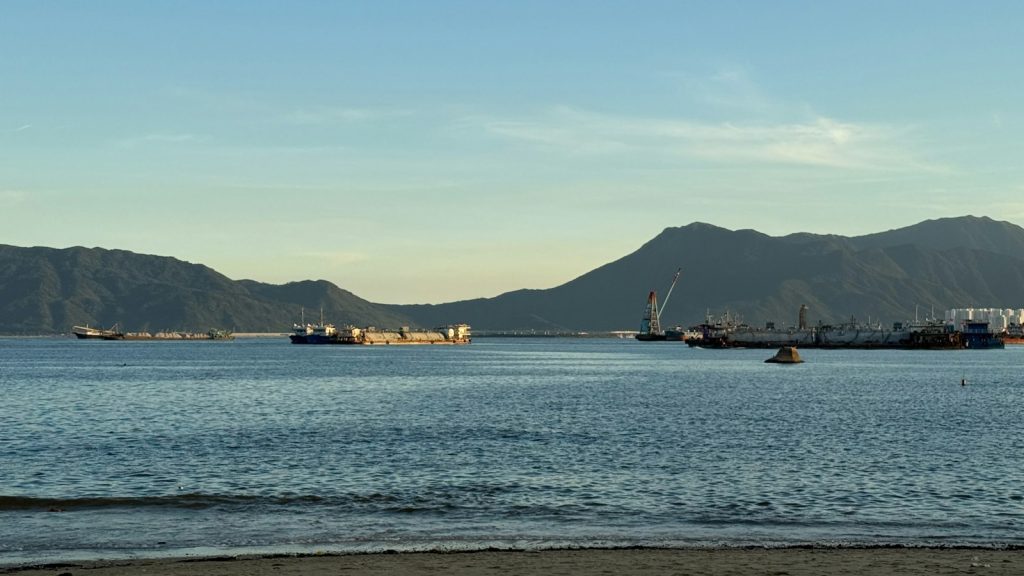
The occurrence took place in Howe Sound, near the Woodfibre LNG site close to Squamish, in the Canadian province of British Columbia. A tug was pushing a barge toward a floating accommodation unit at the site when the barge struck a workboat that was standing by. The workboat capsized and sank; its operator, who was alone on board, ended up in water of about 5 degrees Celsius. The casualty was pulled from the water and treated for hypothermia. According to the TSB, a minor spill was identified after the collision, for which containment booms were deployed.
Findings
The TSB determined that a crane on the tug and containers on the barge blocked the operator’s forward view. In addition, light reflecting off the water made the workboat’s navigation light difficult to distinguish. No lookout had been posted at the time of the collision. The workboat operator was facing away from the approaching vessels and was on a phone call that, according to the Board, “likely diverted his attention from keeping watch around the workboat.”
The investigation further found that tug crew members had previously raised informal concerns about reduced visibility and light reflection after a refrigerated container was added to the load in November 2024. Because the crew routinely encountered such issues, the TSB found that these concerns did not meet the threshold for a formal hazard report. Before the container was loaded, stability had been assessed, but visibility had not. The TSB further concluded that the safety management systems of the various contractors working at the site were not aligned with one another, with the result that hazards were not consistently identified, reported, and controlled. Workboats routinely stood by at the collision site without the tug operator’s knowledge, and the tug’s movement schedule never reached the workboat operator. Finally, the operator was working alone, even though another contractor’s site protocol specified that subcontractors must never work alone where uncontrolled entry into the water is possible; the workboat operator was not aware of that requirement.
Safety Action Taken
The published investigation report contains no new formal TSB recommendations; the Board limits itself to determining causes and contributing factors and, in keeping with its mandate, does not make findings of fault or civil liability. The companies involved have, however, taken safety action on their own initiative following the occurrence. The tug operator now maintains a continuous lookout and restricts barge movements to daylight hours. The workboat operator has crewed observation vessels with two people and introduced cold-water immersion training. No formal fine or sanction is mentioned in the available reporting.
Context
The TSB first identified a structural gap in the oversight of tug and barge operations in Canadian waters in 2017. Following a March 2016 occurrence in which a tow line parted in a storm off British Columbia and two barges grounded, the Board recommended that tug and barge operators be required to carry a safety management system, as conventional cargo vessels of comparable size already do. Safety management in marine transportation remains on the TSB’s Watchlist. The Squamish occurrence illustrates that a lack of alignment between the safety systems of different contractors at a single site remains a recurring issue.
Blocked sightlines, the absence of a posted lookout, and unharmonized safety procedures between contractors are not a uniquely Canadian problem: the same risks arise at any port or industrial site where multiple companies operate their own vessels, cranes, or heavy equipment side by side, from LNG terminals to offshore wind farms and container terminals. The occurrence underscores the importance of a dedicated, posted lookout in conditions of restricted visibility, and of a single shared hazard-reporting system when different contractors share the same site.
Source: Blocked sightlines, lookout gaps behind Squamish LNG site collision, 02-10-2026
Additional research: Transportation Safety Board of Canada, investigation page M24P0265, Canadian Underwriter, TSB recommendation on mandatory safety management systems for tug/barge operators