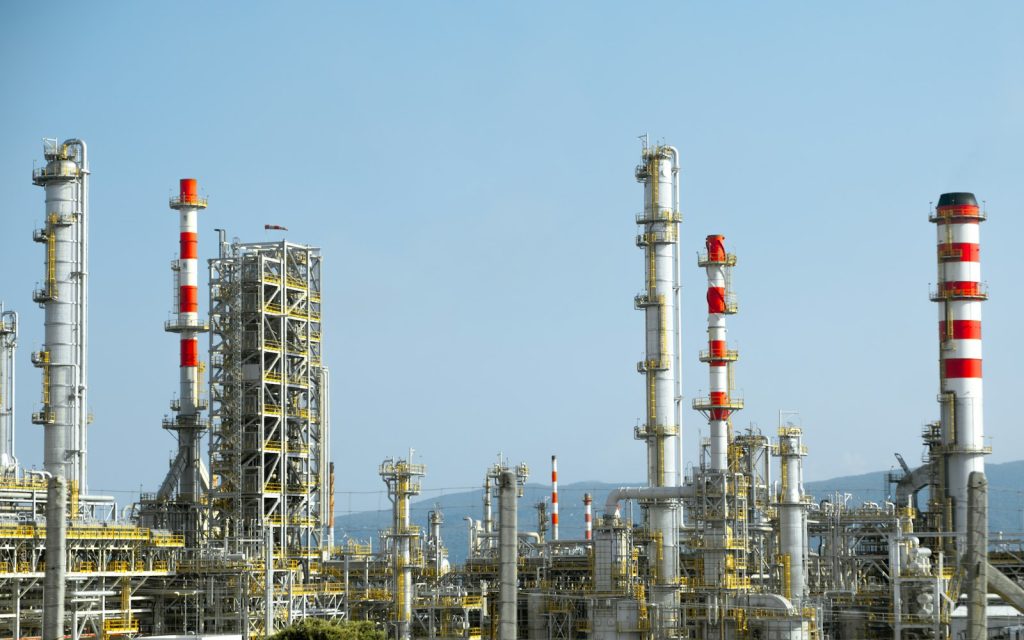
The U.S. Chemical Safety Board (CSB) has released a new safety video about the fatal fire on September 20, 2022, at the refinery in Oregon, Ohio, United States, which was operated at the time by BP as the BP-Husky refinery. Two BP employees, brothers, died in the incident after a cloud of vaporized naphtha ignited near a furnace. The video, titled “Alarming Mistakes, Deadly Decisions: Fatal Fire at BP-Husky,” summarizes the findings of the final report the CSB published in 2024.
Incident
The incident began with a process upset in the refinery’s naphtha hydrotreater at around 3:20 a.m. To address it, other units were shut down, which caused liquid naphtha to accumulate in a pressure vessel that normally holds only fuel gas: the fuel gas mix drum. The vessel overflowed, and naphtha flowed through the gas piping to furnaces and boilers.
Operators were instructed to drain the vessel as quickly as possible. Two employees, brothers, opened valves to do so, releasing naphtha onto the ground; the CSB believes they mistook it for a non-flammable amine-water mixture. The released liquid – more than 10,000 kilograms – vaporized into a flammable vapor cloud, which ignited near a furnace fire in Crude Unit 1 at around 6:46 p.m. Both employees died in the resulting flash fire; the CSB estimates property damage, including business interruption losses, at approximately $597 million.
The accident was preceded by a period of nearly 12 hours in which more than 3,700 alarms sounded – an “alarm flood” that overwhelmed the operators. During a mid-afternoon meeting, managers and process engineers decided not to shut down or circulate Crude Unit 1. An email summarizing the meeting was never sent, and according to the CSB there is no evidence that the agreed actions reached the night shift.
Findings
In its final report, the CSB identifies four safety issues. First, the safeguards to prevent liquid overflow were inadequate. Second, management of the abnormal process conditions fell short. Third, the alarm flood caused delays and errors in responding to critical alarms and in communication. Fourth, the company failed to adequately learn from a similar occurrence in 2019, in which naphtha likewise filled the vessel: the investigation that followed recognized warning signs of a catastrophic incident but produced no actions to prevent a recurrence. The CSB also sees similarities between the overflow in this incident and the one involved in the 2005 explosions and fires at the BP refinery in Texas City, which killed 15 workers. The Ohio fire is the deadliest incident at a BP-operated U.S. refinery since Texas City. CSB Chairperson Steve Owens summed it up: “almost everything that could go wrong did go wrong.”
Recommendations
The CSB made a total of seven recommendations. Four are addressed to Ohio Refining Company LLC, the current owner and a subsidiary of Cenovus Energy: revise the safeguards in the process hazard analyses for high-level and overflow scenarios, revise the policy on abnormal process conditions, revise the site’s alarm philosophy, and develop or revise a stop work authority policy, with procedures and periodic training, emphasizing its use during abnormal situations and alarm floods.
Two recommendations go to the American Petroleum Institute (API): develop or revise a publication on the process hazards of fuel gas mix drum overflow, with guidance on design, sizing, high-level instrumentation and preventive safeguards, and develop a publication on preventing overflow of pressure vessels during normal operation, upsets and transitional situations. The seventh recommendation goes to the International Society of Automation (ISA): supplement the alarm management guidelines with performance targets for short-duration alarm floods. The CSB made no recommendations to BP itself, since the company no longer operates the refinery.
Context
The shortcomings identified in the CSB investigation – inadequate management of abnormal process conditions, overloaded alarm systems and unclear procedures – touch on elements that the U.S. occupational safety authority OSHA prescribes in its Process Safety Management standard (29 CFR 1910.119). That regulation requires companies that work with large quantities of hazardous chemicals, including refineries, to carry out, among other things, process hazard analyses, maintain clear operating procedures, apply a systematic approach to process changes, and investigate incidents. It is precisely that last element that connects to the CSB’s finding that the lessons from the 2019 occurrence were never translated into action.
Process safety at refineries and chemical facilities is not a uniquely American issue: wherever large volumes of flammable or toxic substances are handled under pressure, alarm management, clear procedures for abnormal situations, and employees’ authority to stop work in time all play a role. The CSB’s findings are therefore also relevant to facilities outside the United States.
Source: CSB video on fatal fire at Ohio BP-Husky refinery (2022), October 13, 2026
Additional research: CSB press release on final report, BP-Husky refinery, OSHA Process Safety Management standard