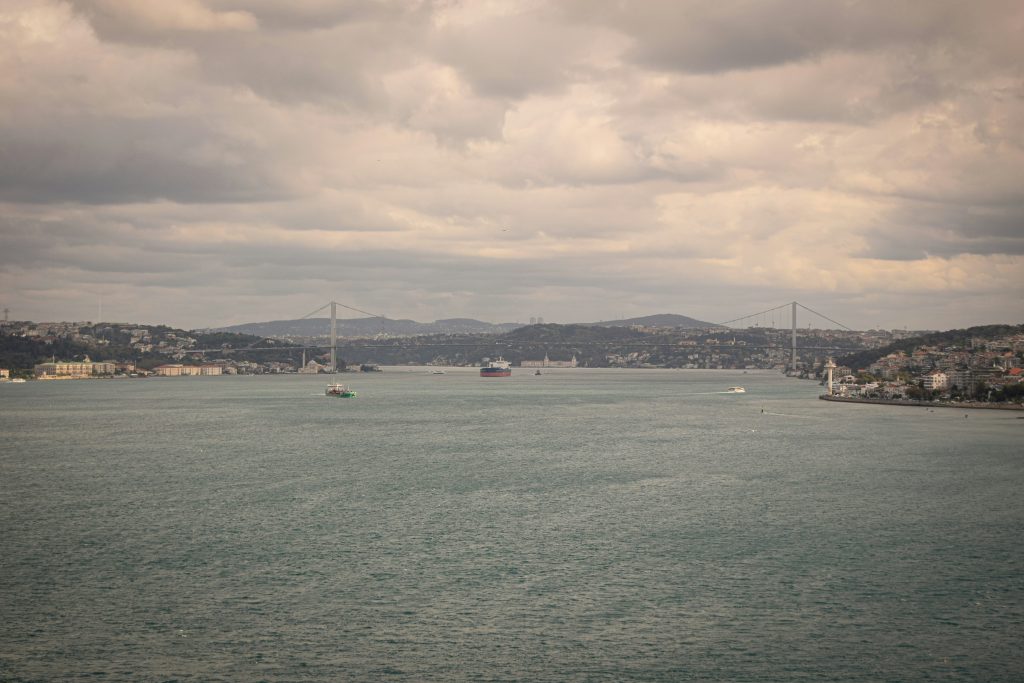
On 19 July 2024, the towing vessel Miss Peggy capsized and sank after the bulk carrier Yangze 7 struck her stern in the Houston Ship Channel, Texas, United States. One deckhand was killed and two other crew members were injured. In a report published on 6 August 2026, the U.S. National Transportation Safety Board (NTSB) concludes that the pilot aboard the Yangze 7 had spent 39 minutes on a personal phone call immediately before the collision.
What happened
The collision occurred at 2:03:35 p.m. local time near Lynchburg, Texas, United States. The bulbous bow of the roughly 200-metre, Liberian-flagged Yangze 7 struck the stern of the Miss Peggy, a 15.3-metre American towing vessel with five crew members aboard. The towing vessel capsized and sank almost immediately. Four crew members were rescued by the bystander vessel George M; the deckhand was later found dead in the wreck.
According to the report, the Houston pilot aboard the Yangze 7 — commissioned in March 2023 and by that point having completed 443 prior transits — took a personal call at 1:22:39 p.m. from a fellow pilot who was at that moment aboard the tanker Petrel. The call, covering golf, the purchase of a home generator, and travel plans to France, lasted 39 minutes and 5 seconds and ended at 2:01:44 p.m. — just 1 minute and 51 seconds before the collision.
The Yangze 7’s second officer stated that he felt “very scared” because the pilot kept talking while he was issuing helm orders. He recognized that the conversation had nothing to do with navigation but did not dare raise the matter with the captain. The bridge team did not spot the Miss Peggy until she was less than one ship’s length off the bow. The NTSB also found that the captain of the Miss Peggy, who had 17 years of towing experience, failed to maintain an adequate lookout.
Cause: distraction on the bridge
The NTSB determined the probable cause as follows: “the probable cause of the collision between the bulk carrier Yangze 7 and towing vessel Miss Peggy was the loss of situation awareness of the Houston pilot, the Yangze 7 bridge team, and the captain of the Miss Peggy due to a failure to maintain a proper lookout.”
At the time of the accident, the Houston pilots’ organization had no policy in place prohibiting the non-operational use of personal electronic devices during active vessel movements. The NTSB further notes that distraction from personal devices contributed to at least ten other maritime accidents between 2009 and 2024, resulting in a combined total of three deaths and 45 injuries.
Total damage from the accident is estimated at approximately $3.7 million — roughly €3.4 million at current exchange rates. The Miss Peggy was declared a total loss, with an appraised value of $1.4 million (roughly €1.3 million).
NTSB recommendations
The NTSB makes two recommendations. It recommends that the U.S. Coast Guard, the federal maritime regulator, prohibit the non-operational use of personal electronic devices by individuals directing the movement of a vessel, such as pilots and helmsmen. It also recommends that the American Pilots’ Association, the U.S. industry body for pilots, develop and implement similar guidance and encourage affiliated pilot associations to adopt it.
Source: NTSB Marine Accident Report MIR-26-24, 6 August 2026, https://www.ntsb.gov/investigations/AccidentReports/Reports/MIR2624.pdf
Related articles
Explosion Aboard Sludge Vessel Hunts Point: Unauthorized Hot Work Proves Fatal

Fines and community service after fatal workplace accident involving 16-year-old intern in Tubbergen, the Netherlands