Leggett & Platt Components Europe Ltd has been fined by Leeds Magistrates’ Court for a breach of UK workplace safety law, after a collision between two transport vehicles in the company’s warehouse in Barnsley, United Kingdom. An employee sustained multiple foot fractures and long-term nerve damage as a result. An investigation by the UK’s Health and Safety Executive (HSE) found that a change to the transport routes, made for the installation of new automated machinery, had not been risk-assessed in advance.
What went wrong?
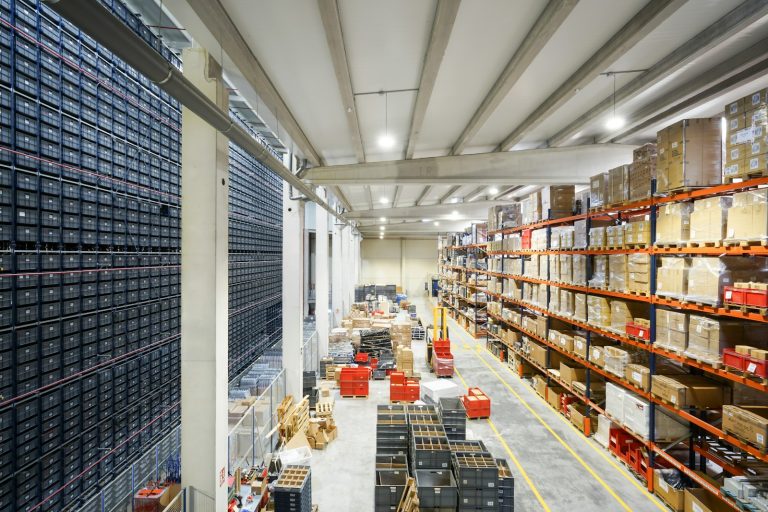
The accident happened on 14 November 2024 at the company’s Long Royd warehouse, a manufacturer of bed springs, in Barnsley. While installing new automated production machinery, the company had altered the transport routes in the warehouse. As a result, pallet trucks and forklifts had to share the same route, in a busy loading and unloading area with limited visibility and increased vehicle movement. An employee, 20 years old at the time, was riding an unguarded ride-on pallet truck when it collided with a forklift driven by a colleague. The employee sustained multiple fractures in his foot and was left with long-term nerve damage.
Conclusions
HSE found that during the installation period the company focused mainly on installing the machinery and had underestimated the safety implications of the altered transport routes; those changes had not been properly risk-assessed in advance. Several risk factors therefore came together on the adjusted route: shared use by different types of vehicles, increased vehicle movement and limited visibility in the loading and unloading area. The company was prosecuted for a breach of section 2(1) of the Health and Safety at Work etc. Act 1974, which requires employers, so far as is reasonably practicable, to ensure the health, safety and welfare at work of their employees. Leggett & Platt Components Europe Ltd pleaded guilty and was fined £80,000 by Leeds Magistrates’ Court on 20 October 2026, plus £3,374 in costs.
Recommendations
According to HSE, the accident could have been prevented with good planning and a prior risk assessment of the altered transport routes. HSE inspector Chris Parker stressed that employers must assess the wider safety implications of changes, even when those changes are temporary, such as during the installation of new machinery. Employers must assess and control the risks of altered transport routes before those routes are brought into use. For guidance on safe workplace transport, HSE refers to its own website.
Context
HSE’s general guidance on workplace transport safety emphasises that traffic routes should be designed so that pedestrians and vehicles can use them safely; roadways and footpaths are separated wherever possible, and pedestrians stay out of areas where vehicles are working unless that is necessary. Among other things, the guidance recommends physical separation, clear marking and signage, separate doors for vehicles and pedestrians, good visibility at crossing points, and limiting route use at busy times such as shift changes. A risk assessment of the transport routes forms the basis for this, with attention to how and where routes are shared and how crossing points are laid out. Although that guidance mainly concerns the separation of pedestrians and vehicles, the underlying approach aligns with HSE’s conclusion in the Barnsley case that even temporary changes to transport routes, such as during the installation of new machinery, must not be made without a prior risk assessment. Traffic management in warehouses is a universal safety issue: wherever forklifts, pallet trucks and pedestrians share the same space, a seemingly temporary change to the layout can create new collision risks.
Source: Bed springs company fined after worker injured in warehouse collision, 23 October 2026
Additional research: HSE – Separating pedestrians and vehicles