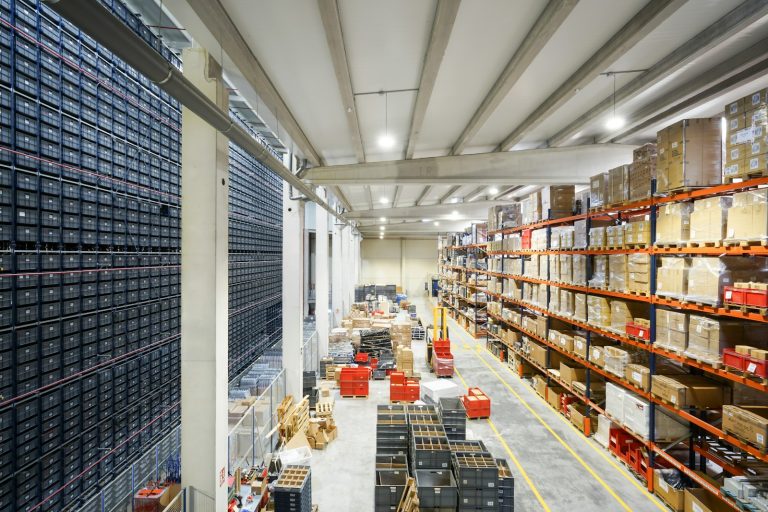

City Electrical Factors Limited, an electrical wholesaler and manufacturer based in Telford, United Kingdom, has been fined £4,000,000 plus £6,304 in costs following a serious lifting incident that left an employee with permanent, catastrophic injuries. Birmingham Magistrates’ Court delivered its ruling on 16 October 2026; the company pleaded guilty to breaching Section 2(1) of the Health and Safety at Work etc. Act 1974, the UK’s workplace safety law.
Circumstances
On 4 October 2024, an employee of the company was working as a “spotter” while heavy switchgear was being loaded onto a flatbed lorry. The incident occurred at the company’s Proteus Switchgear Industrial Division. A forklift truck was loading a 231-kilogram switchboard onto the lorry. Instead of securing the load to the forklift, employees were posted as “spotters” to steady the load by hand while it was being moved and lifted. The UK’s Health and Safety Executive (HSE) describes this as an unsafe and unnecessary way of working. The load fell and struck the employee.
The employee suffered brain and spinal cord injuries and required life-saving surgery. He has since been unable to care for himself or communicate, and now lives in a care home where he needs 24-hour care. The injuries are permanent; the incident was not fatal.
Findings
The HSE’s investigation found that no risk assessment had been carried out and no lifting plan existed, even though loading this type of switchgear was a routine task at the company. Employees had received no instructions on how to move and secure the load safely. According to the HSE, the load could have been secured to existing anchor points on the lorry, or lifted using the crane fitted to the lorry via the lifting eyes already mounted on the switchboard. Neither of these safer methods was used.
HSE inspector Keeley Eves said of the case: “This incident had truly tragic consequences.” She added that it was “completely avoidable and caused by a failure to properly plan for the job taking place.” According to Eves, the employee was placed at unnecessary risk and now has to live with the devastating consequences of his injuries. She further stressed that loading and unloading remain among the most hazardous transport activities in the workplace.
Recommendations
The HSE calls on employers to always have lifting operations planned, supervised and carried out safely by competent, authorised persons. A lifting plan must address the risks identified in the risk assessment and set out the equipment, procedures and responsibilities involved. The HSE refers to its guidance “Planning and organising lifting operations.” “Employers must ensure that lifting operations are properly planned by competent persons, supervised and carried out safely,” said Eves.
Context
In the United Kingdom, the duty to plan lifting operations, have them carried out by a competent person and supervise them stems from the Lifting Operations and Lifting Equipment Regulations 1998 (LOLER), explained in HSE guidance L113, “Safe use of lifting equipment.” Similar breaches regularly lead to prosecution: in May 2026, Winbro Group Technologies Ltd was fined £170,000 after a fitter’s fingers were crushed during a forklift lifting operation, likewise for failing to properly plan a lifting operation under LOLER. Both cases underline that unplanned lifting and loading work remains a recurring cause of serious, preventable accidents on British worksites.
Relevance for employers, logistics and manufacturing companies worldwide: this incident shows that the absence of a risk assessment and a lifting plan for seemingly routine loading work can lead to catastrophic, permanent injury. Wherever workplace safety law imposes similar requirements for planning and supervising lifting and loading operations, this incident is a warning never to rely on employees as “human tie-downs” when anchor points, lifting eyes or crane equipment are available.
Source: HSE press release: electrical wholesaler fined after serious lifting incident, 16 October 2026
Additional research: HSE guidance L113 “Safe use of lifting equipment” (LOLER 1998) and an HSE press release on a similar LOLER case involving Winbro Group Technologies Ltd (May 2026).