
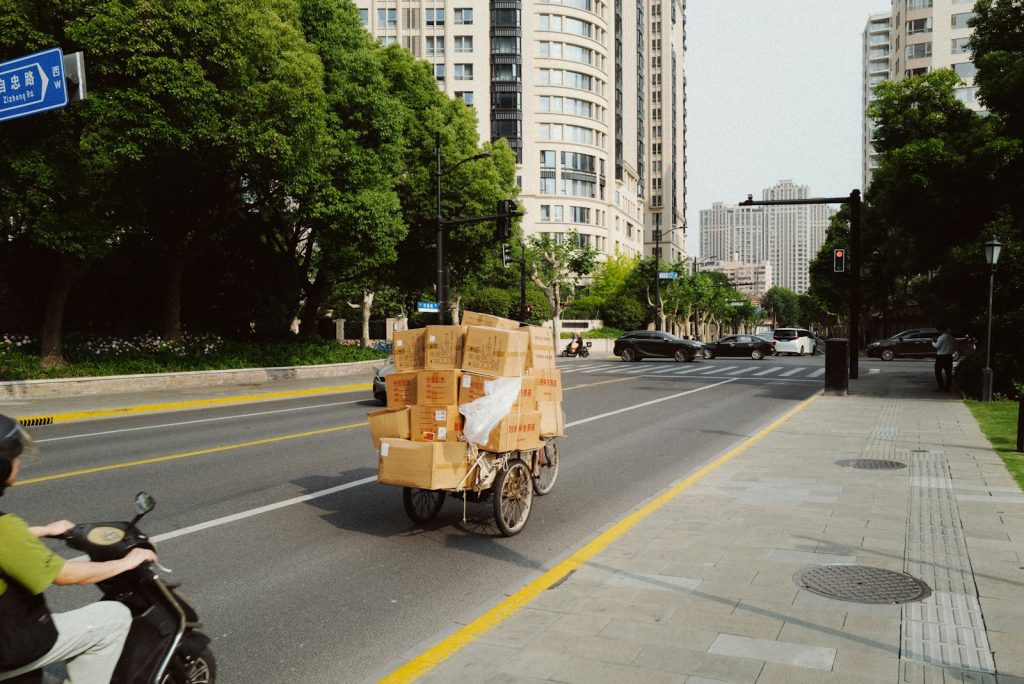
One in three platform couriers in Spain works more than ten hours a day very regularly, and penalties for refusing a delivery are the most common sanction, affecting 81.9% of penalized couriers. This is according to a study by Spain’s national institute for safety and health at work (INSST) among 804 food and drink couriers who work through digital platforms.
Who are the platform couriers?
Between September and November 2024, INSST surveyed 804 couriers in twenty Spanish municipalities with more than 230,000 inhabitants, mainly Madrid and Barcelona (margin of error ±3.42%, confidence level 95%). The average age is 30, and 85.6% are men. More than eight in ten couriers (80.7%) were born outside Spain, two-thirds (66.9%) come from Latin America, and 67.5% do not hold Spanish nationality. Slightly more than four in ten (43.2%) work as self-employed, 33.8% have employee status, and 34.1% work for multiple platforms at the same time. For 87.1%, delivery work is their main source of income, and 83.7% earn 76 to 100% of their monthly income from this work.
What psychosocial risks does the study identify?
The study maps out intensive working patterns: 82.8% frequently work on weekends or public holidays, 51% very regularly make night deliveries, and 33.6% very often work more than ten hours a day. Almost a quarter (23%) frequently have less than 48 consecutive hours of rest per week. Only 17% say they can regularly combine work and private life well; among couriers without Spanish nationality, 85.8% say they never or rarely manage to do so. Algorithmic management is a key factor: for 73.9%, delivery assignments are allocated by the algorithm, and only 32.7% feel free to refuse an assignment. Refusing has consequences: 85% say a refusal counts against future assignments, 61.4% were given a zone restriction, and 19.7% were (temporarily) blocked from their account. The report also points to the geographic dispersion of couriers, which limits mutual support among colleagues, and to safety risks: 40% do not wear personal protective equipment.
What does INSST recommend?
The institute recommends, among other things, actively encouraging the use of protective equipment, particularly among couriers with employee status, making access to platforms fairer, and tackling informal practices such as subletting accounts: 18.4% of respondents work without their own platform account. INSST also calls for more targeted integration policy, given that the profession is made up predominantly of migrants.
Context
Similar signals emerge from a study of 240 couriers in Milan, Italy, published in October 2024 in the journal La Medicina del Lavoro: 39% of them had been involved in a traffic accident (51% among e-bike users), and 13% of all couriers needed hospital care after an accident. In addition, 63% reported health complaints; of these, 59% suffered from back pain and 49% from fatigue, and 28% experienced verbal aggression. This suggests that the risks of platform delivery work are not unique to Spain.
Source: Factores de riesgo psicosocial en el colectivo de repartidores de comida y bebida que operan mediante plataformas digitales: conclusiones estudio 2024-2025, 23 September 2026
Additional research: La Medicina del Lavoro, October 2024: https://pmc.ncbi.nlm.nih.gov/articles/PMC11562669/


