A construction company has been fined CAD 75,000 after a worker was injured in a trench explosion during foundation work in Ottawa, Canada. The explosion occurred when vapours from a flammable adhesive accumulated in the unventilated trench.
What happened?
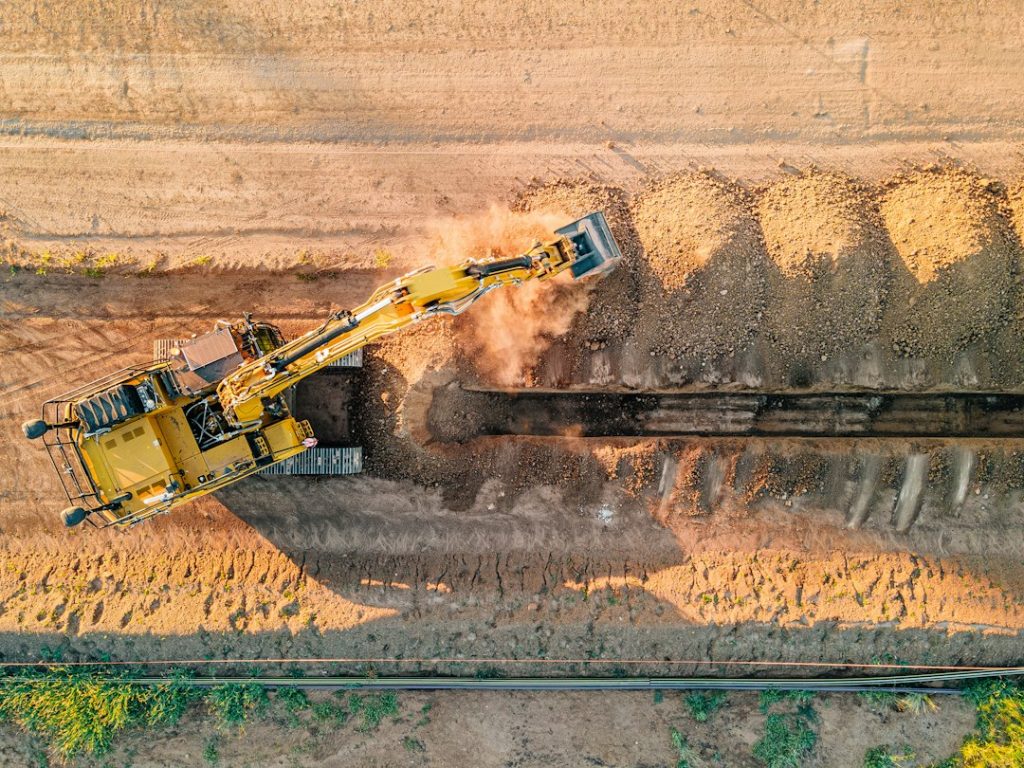
On August 30, 2023, employees of 8169195 Canada Inc., operating as Above Water and based in Gatineau, Quebec, were carrying out foundation repair work at a home in Ottawa, in the Canadian province of Ontario. The unshored excavation was approximately 2.4 metres deep and 0.9 metres wide; because its depth exceeded its width, Ontario construction regulations classify it as a trench rather than an ordinary excavation. A worker was applying Henry Blueskin adhesive to the rear foundation wall as part of the waterproofing work. This product is a flammable liquid that can produce ignitable vapours during application. Because the trench was narrow and deep, the vapours could not disperse naturally and accumulated in the confined space. An explosion occurred while the adhesive was being applied, injuring the worker. The source does not state the worker’s age, job title, or the precise nature of the injury.
Findings
An investigation by the Ontario Ministry of Labour, Immigration, Training and Skills Development found that no atmospheric monitoring or ventilation was used while the flammable adhesive released vapours into the trench. As a result, an ignitable air-vapour mixture could form unnoticed. The combination of a narrow, deep trench and a flammable product used without gas monitoring or ventilation meant the vapours had no way to escape. The Canadian Centre for Occupational Health and Safety (CCOHS) notes that vapours from flammable liquids can travel along the ground before igniting, and that in a trench they also tend to linger at working height. The source does not state what ultimately ignited the vapours.
Recommendations
On July 15, 2026 – nearly three years after the incident – 8169195 Canada Inc. was found guilty of violating section 46(1)(b) of Ontario Regulation 213/91, the provincial construction projects regulation made under Ontario’s Occupational Health and Safety Act; the violation was recorded under section 25(1)(c) of that Act. That section requires precautions whenever a gas, vapour, dust, or fume could form an explosive mixture with air. The court imposed a fine of CAD 75,000, plus the mandatory 25 percent victim surcharge (CAD 18,750), bringing the total to CAD 93,750. The Canadian Centre for Occupational Health and Safety (CCOHS) advises that flammable liquids be used only in well-ventilated spaces, with spark-free tools and explosion-proof equipment. For confined, deep spaces such as trenches, it therefore makes sense to monitor and ventilate the atmosphere before and during the use of such products, and to begin work only once the air has been confirmed safe.
Context
The case fits within broader Ontario regulations on trench work. Under Ontario Regulation 213/91, any trench deeper than 1.2 metres must be protected against collapse through sloping, shoring, or a prefabricated support system, and the soil must first be classified by type. Employers must also have cables and pipelines located in advance, keep the excavation free of accumulated water, and have the trench inspected daily by a competent person before workers enter. These general rules focus mainly on collapse hazards, but the case against Above Water shows that fire and explosion risk from chemical vapours in a trench is a real, separate hazard requiring its own precautions, such as gas detection and mechanical ventilation.
Ontario regularly enforces rules on trench work. In 2024, for example, a greenhouse manufacturer in Leamington was fined CAD 65,000 after a worker was seriously injured when a trench collapsed. The Ottawa case shows that regulators are also addressing chemical hazards in trenches.
Source: Ottawa trench explosion: company fined after worker injury, October 1, 2026