
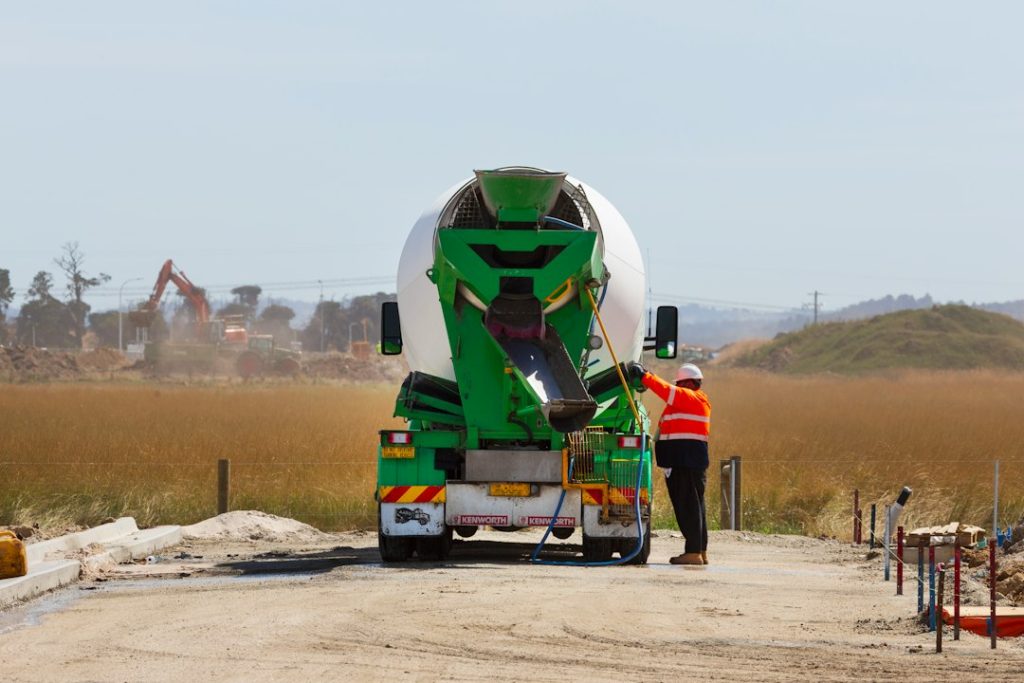
Concrete mixer trucks are among the heaviest and highest-risk vehicles on a construction site. Prevencionar México, a Mexican occupational safety organization, published an overview on 11 September 2026 of the main hazards and preventive measures involved in working with these machines. The article lists a series of risks that arise during driving, unloading and maintenance, and describes concrete steps for preventing accidents.
Rollover risk and collisions among the main hazards
According to the publication, collisions and crush injuries during manoeuvres, particularly while reversing, are among the greatest dangers. The article also highlights the risk of tipping over or losing stability on uneven ground or near excavation trenches, hand and finger entrapment in the chutes and hinge points of the discharge unit, falls from ladders and platforms during inspection and cleaning, contact of fresh concrete with skin and eyes, flying debris during unloading and cleaning, and noise exposure during maintenance work. The article stresses that “reversing must be kept to a minimum and should only take place when it can be guaranteed that the area is clear of personnel.” Before discharging concrete, checks must include the stability of the ground, the absence of workers in the vehicle’s path, the distance to trenches and level differences, and sufficient manoeuvring space.
Safe handling of discharge chutes and unloading
When operating the discharge chute (canaleta), Prevencionar México advises, among other things, never to place hands near the hinge points, to stay clear of the chute’s swing radius, to work from a stable position, to avoid jerky movements, and to check the locking mechanisms before the vehicle moves off. Discharging concrete is identified as “a specific high-risk operation”: when cranes or hoppers are used, the rule is never to stand beneath a suspended load or position oneself between a moving load and the truck.
Personal protection as a supplement, not a substitute
Recommended protective equipment includes eye protection against splashes, suitable gloves, safety footwear, protective work clothing and hearing protection where needed. The article emphasizes, however, that personal protective equipment “should be regarded as a supplementary measure” and is no substitute for safe working conditions. For cleaning and maintenance as well, it must first be guaranteed that “no unexpected start-up or movement can occur,” and ladders and platforms must be stable and slip-resistant. In total, the article lists 21 concrete preventive measures, including route planning, separation of vehicles and pedestrians, periodic inspection of components, and training for drivers and workers. The conclusion: a significant proportion of accidents can be prevented through proper traffic organization and clear demarcation of the unloading zone.
Source: Camiones hormigonera: medidas preventivas para trabajar con seguridad, September 11, 2026


