
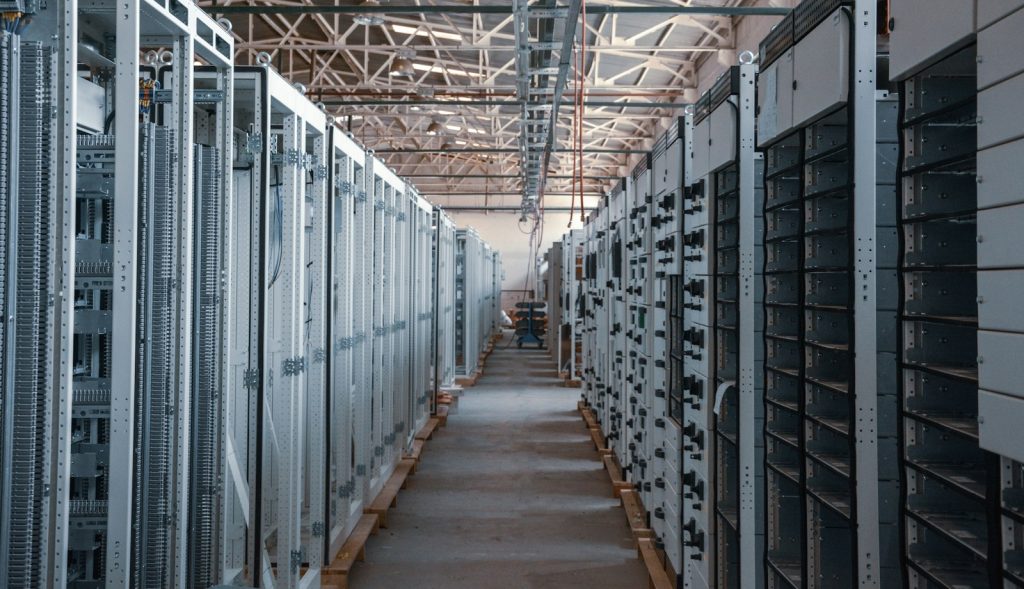
Lithium-ion batteries are taking over from traditional lead-acid batteries as backup power in a growing number of Canadian data centers. They bridge the short gap between a power outage and the start-up of the backup generators. The batteries are more compact and powerful than lead-acid batteries, but their high energy density brings a new kind of fire risk, warns Brian O’Connor, senior engineer at the US National Fire Protection Association (NFPA), in the Canadian trade publication Canadian Occupational Safety.
Why do lithium-ion batteries pose a new fire risk?
A fire in a lithium-ion cell usually starts when the internal separator is damaged or becomes too thin, causing a short circuit. The resulting heat vaporizes the electrolyte into a flammable, toxic gas, which can rupture the cell in a torch-like flare; in an enclosed space this can even lead to an explosion. According to O’Connor, fire safety must therefore be built in from the design stage, not added afterwards.
How does a fire spread between battery cells?
Because battery cells are often packed tightly together, a fault in one cell can spread to its neighbors within seconds. “The six to nine battery cells all around that first one have already started to fail,” says O’Connor. “From that point on, it’s kind of like a domino effect.” Some systems have heat barriers between cells, but this is not a fixed standard. The robust casing that makes the batteries durable also makes it harder for firefighters to reach the cells with water once they ignite. According to O’Connor, data centers often have advanced detection and suppression systems; gas suppression is widely chosen to protect costly equipment.
How can data centers manage the risk?
Data centers already carry significant heat and electrical risks of their own. Batteries are deployed as uninterruptible power supplies (UPS), sometimes bundled in one central bank, sometimes spread across server racks. The article refers to NFPA 855, the US standard for the installation of stationary energy storage systems. Emerging liquid cooling is pushing storage density even higher, increasing the value of equipment at risk in a fire. According to the source, this trend aligns with recent engineering research at the University of Waterloo (Ontario, Canada) into battery risks in AI data centers. O’Connor argues for a lifecycle approach rather than a one-off installation step: “Make sure that safety is brought to the table very early on in the planning stages.” Because large installations, like consumer batteries, lose capacity over time, the end of their service life must also be planned in advance: “You don’t want to end up with a big, abandoned battery system somewhere,” O’Connor says. Lead-acid batteries also carry a risk of thermal runaway and are more familiar to firefighters, but lithium-ion is lighter and delivers more power in less space, which makes the fire safety plan more complex.
Context
That this is not a theoretical risk became clear on 26 September 2025, with a fire at a data center in Daejeon, South Korea: a suspected battery explosion there triggered thermal runaway in nearly two hundred lithium-ion battery packs, knocking out hundreds of online government services, reported International Fire and Safety Journal. South Korea’s National Fire Agency recorded 296 battery fires in the first half of 2025 alone, with 23 casualties and KRW 22.4 billion in damage. According to analysis firm IDTechEx, no global regulation yet exists for battery storage systems in data centers, while data center electricity consumption is expected to more than triple within a decade.
For HSE professionals worldwide, this development underscores that battery storage is not merely a technical or financial issue, but part of fire safety policy that demands attention in nearly every jurisdiction. As facilities switch to lithium-ion backup, the need grows to jointly review detection, suppression capacity, emergency responder training and end-of-life planning, rather than treating fire safety as a one-off permitting requirement.
Source: Lithium-ion batteries bring new fire risks to Canadian data centres, October 30, 2026
Additional research: Fire prevention lessons emerging from data centre battery failures, International Fire and Safety Journal, October 6, 2025