
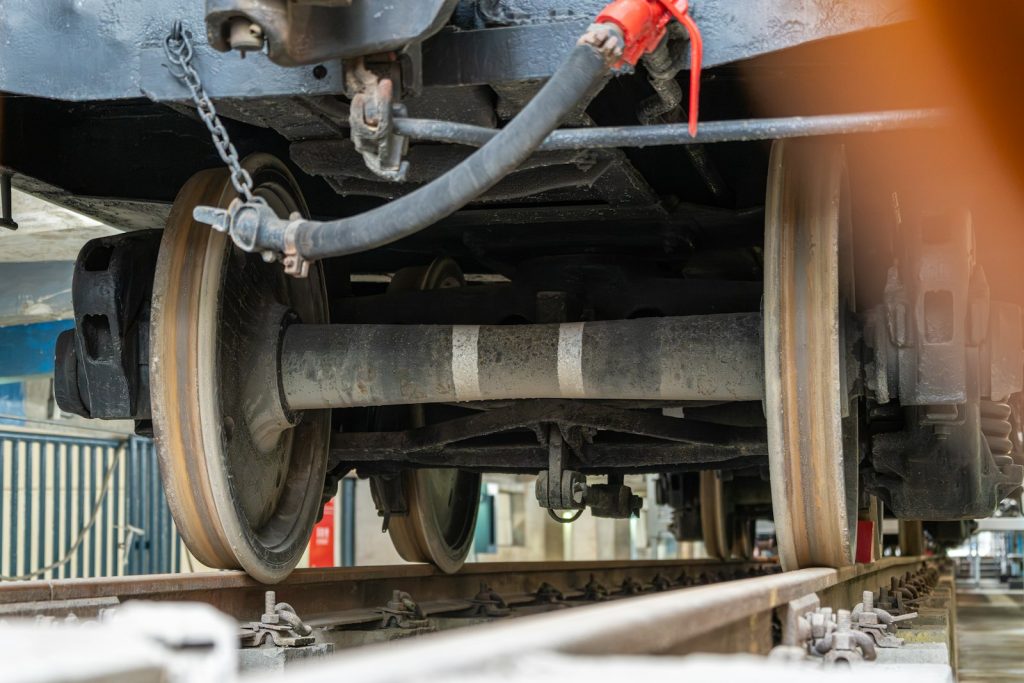
An investigation into a 2023 derailment near Uncas, Alberta, has found that Canadian railways could prevent more wheel-related derailments by making better use of data they already collect, rather than investing in new sensor technology.
Crack in a 30-year-old wheel
On April 5, 2023, eighteen grain cars on a Canadian National Railway (CN) train derailed near Uncas, Alberta, on the Wainwright Subdivision. The Transportation Safety Board of Canada (TSB) found that a wheel failed when a fracture developed in the rim below the tread, causing the rail to break. The wheel had been manufactured in 1991 — well before the Association of American Railroads (AAR) introduced its first formal steel-purity standard in 2003. No one was injured, though grain spilled from the cars. Robert LeBlanc, a senior investigator at the TSB’s Edmonton, Alberta, office, says visual inspections simply can’t catch this kind of flaw: “Even as good as visual inspections can be, they’ll never detect what we call subsurface defects.”
Trackside sensors already measure impact loads
Canadian railways have used Wheel Impact Load Detectors (WILD) for years — trackside sensors that measure the dynamic force each wheel exerts on the rail as it passes. Once a reading tops 90,000 pounds (roughly 400 kN, or just over 40 tons), the wheel is flagged for removal at the next certified inspection point. The Uncas wheel crossed that threshold shortly before it failed and was automatically flagged for removal in Edmonton, Alberta — but it broke about 40 km (25 miles) short of getting there. LeBlanc says there’s “a story in the data” that railways aren’t fully reading: individual WILD readings are rarely compared against a wheel’s own history of earlier passes.
TSB: look for trends, not new technology
The TSB’s conclusion is that railways should analyze their existing WILD data more systematically for trends tied to individual wheels, rather than simply checking each reading against a single threshold — the same shift the industry already made for bearing-temperature detectors, says Abe Aronian, a senior investigator with the TSB’s Prairie region. Recommendation R26-02 calls on Transport Canada to work with the rail industry to build out that kind of trend-based WILD analysis. The TSB estimates that roughly a million wheels in service across North America predate the 2003 standard, and about 250,000 of them will soon reach the age at which they need reprofiling.
Context
Wheel safety on freight cars is also drawing scrutiny outside North America. After a cracked wheel derailed a freight train in Switzerland’s Gotthard Base Tunnel in August 2023 — causing roughly €160 million in damage even though the wheel had logged only 50,000 km (just over 31,000 miles) — the European Union Agency for Railways (ERA) approved tighter inspection intervals in December 2025. Wagons fitted with brake blocks that bear directly on the tread now face mandatory inspection after no more than 50,000 km, the strictest tier in a new schedule running from 50,000 to 300,000 km, down from a previous ceiling of 660,000 km. So while Canada is pushing for smarter use of the sensor data it already has, Europe is, for now, leaning on shorter mandatory inspection intervals to head off wheel failures.
Source: Existing wheel data could prevent more Canadian rail derailments, September 25, 2026
Additional research: ERA Approves 50,000 km Freight Wheel Rules in Europe, Railway News, September 22, 2026


